The Product Truth Layer (and why it’s now your #1 growth lever)
Last week we covered the wake-up call: AI shopping is compressing the funnel into one moent.. the answer.
If you ran the AI Shelf Audit, you now have screenshots of the gaps—here’s how to fix them at scale.This week is the fix.
Because once assistants become the shelf… the only thing that matters is whether the assistant feels confident recommending you.
And confidence doesn’t come from vibes.
It comes from truth consistency across the internet.
Not your “brand story.” Your product facts.
Price. Variants. Shipping. Returns. Materials. Warranty. What it’s best for. What it’s bad for. Reviews. Creator proof. Third-party mentions.
| If those facts are messy, the assistant hedges. And hedging is how you lose the recommendation — even if your product is better. So here’s the move: you build a Product Truth Layer the assistant can’t ignore. |
What We’re Seeing Right Now
Most brands think they have a conversion problem.
They actually have a truth problem.
Here’s how it shows up:
- Variant chaos
Your “same product” reads like 12 different products depending on the page, the feed, or the marketplace. - Policy fog
If shipping and returns aren’t instantly clear, the assistant plays it safe and recommends someone else. - Proof gaps
You make claims… but the web doesn’t back them up with reviews, photos, UGC, or credible mentions. - Inconsistent specs
Materials, sizing, compatibility, durability — scattered, incomplete, or contradictory.
Assistants don’t punish you with a bad rank.
They punish you by not mentioning you at all.
The “Truth Stack” (Build this once, then scale it)
Think of your Product Truth Layer like a stack:
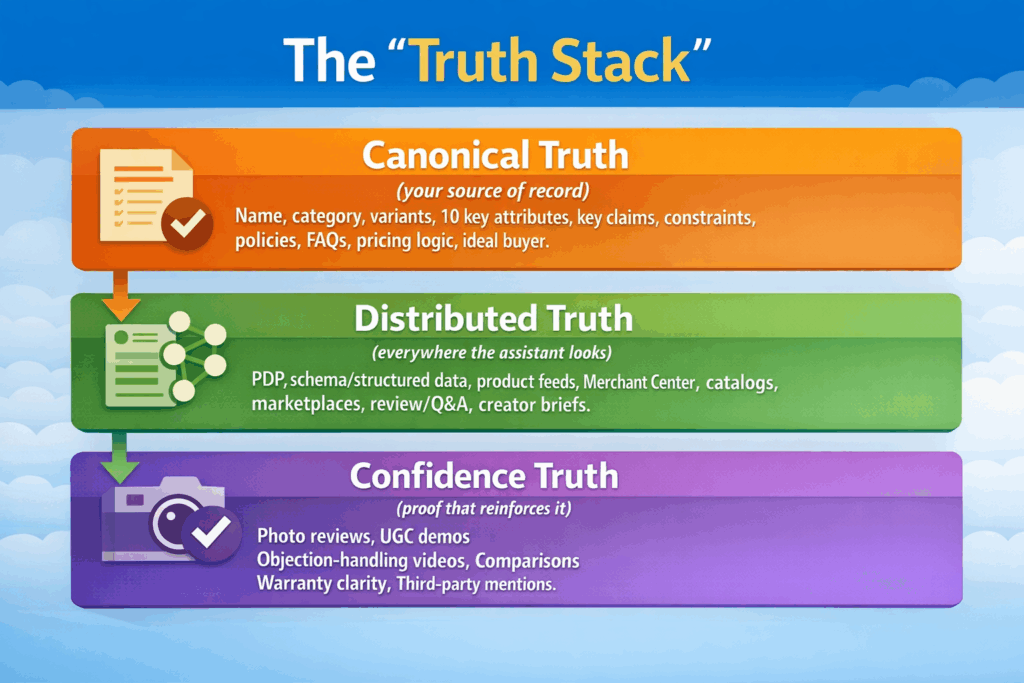
- Canonical Truth (your source of record)
Create a one-page “Truth Sheet” for each hero SKU:
Name, category, variants, 10 key attributes, key claims, constraints, policies, FAQs, pricing logic, ideal buyer. - Distributed Truth (everywhere the assistant looks)
Push that truth into the surfaces that matter:
PDP, schema/structured data, product feeds, Merchant Center, catalogs, marketplaces, review/Q&A, and creator briefs. - Confidence Truth (proof that reinforces it)
Build proof assets that make the claims feel safe to repeat:
photo reviews, UGC demos, objection-handling videos, comparisons, warranty clarity, third-party mentions.
| Your job isn’t to “game” the assistant. Your job is to remove uncertainty. |
What Quietly Changed in the Market
Assistants are becoming the default product aggregator.
That means the winners won’t be the brands with the fanciest creative.
They’ll be the brands with the cleanest, most consistent product reality.
Here’s the new competitive edge:
If your product is easy to understand and easy to trust, you get recommended more.
If it’s hard to understand, the assistant chooses the safer option.
Most teams will miss this because it doesn’t feel like “marketing.”But in 2026, product data is marketing.
A Forward-Style Signal Worth Paying Attention To
The next year is going to be a war over “shopping truth.”
Platforms will standardize how agents read products.
Retailers will fight to control checkout.
Assistants will get more opinionated.
And brands will discover the hard way:
You don’t lose because you had worse ads.
You lose because you were hard to recommend.
So if you want a simple north star for the year:
Make your product the easiest to confidently recommend in your category.
That’s the moat.
The Bridge Report: Where Marketers Find Momentum
Trend of the Week
More teams are quietly shifting resources into:
- product feed + catalog cleanup
- review velocity (recency + photos)
- policy clarity (shipping, returns, warranty)
- creator content designed to answer objections
Not because it’s sexy.
Because it’s converting.
Insight of the Week
The fastest-growing brands aren’t “optimizing for AI.”
They’re operationalizing truth.
They’re treating product accuracy like a growth channel.
Strategy of the Week
Run a “Truth Sprint” on one SKU family:
1 week. One category. One source of truth.
Then propagate it everywhere the assistant pulls from.
If you can’t do it for one SKU family, you won’t do it for 200.
Hot take: Your PDP is no longer just a page.
It’s training data.
Question for you:
What’s your top SKU and the #1 objection buyers have when deciding on it?
| Reply with your top SKU and objection — and I’ll tell you the proof asset you need to address it.. |
Fast Four
Tool I’m Testing
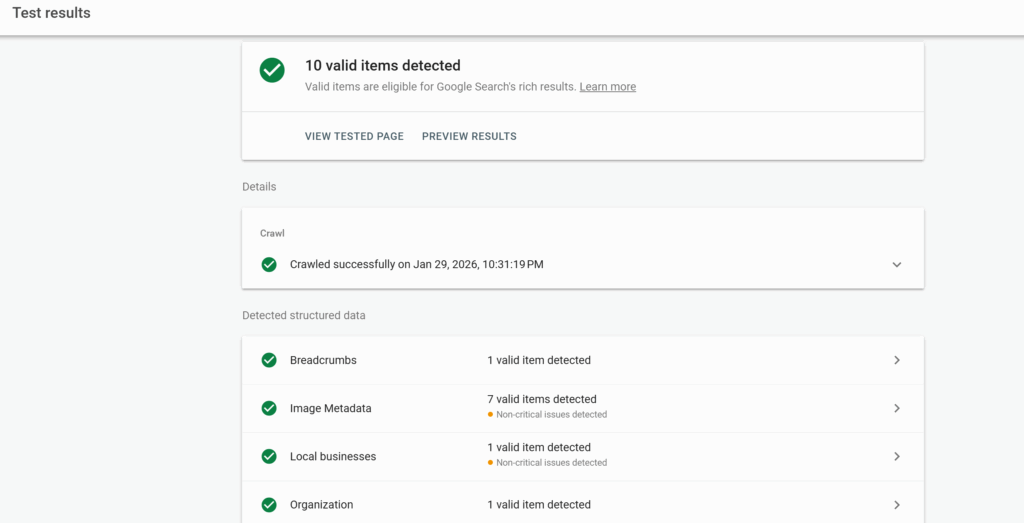
Rich Results Test (validate your Product structured data in minutes)
https://search.google.com/test/rich-results
Article Worth Reading
Intro to Product Structured Data on Google (start here, not in a rabbit hole)
https://developers.google.com/search/docs/appearance/structured-data/product
Prompt of the Week
“Act like a commerce analyst building a ‘Product Truth Sheet.’
Here’s my product: [paste PDP copy + specs + price + shipping/returns + review highlights].
Output:
- Canonical product name + category
- Variant map (size/color/etc.) and the clean naming convention
- The 10 attributes an assistant should use to compare this product
- The top 5 objections buyers have — and the proof we need for each (review type, UGC angle, policy clarity, spec)
- A one-sentence ‘assistant-safe recommendation’ you’d be comfortable repeating verbatim
- The 5 missing facts that would reduce uncertainty the most.”
Resource Worth Stealing
Product variants structured data (so your variants stop looking like separate products)
https://developers.google.com/search/docs/appearance/structured-data/product-variants
Growth Virality Drop
The Ecomm Ads Toolkit (Built for 2026)
If you’re staring at stalled performance and you know it’s not “just make more ads”… this is the shortcut.
The toolkit is built to fix the stuff that actually drives ROAS: creative, offers, funnel flow, and the boring foundations most brands skip.
What’s inside:
- Custom ROAS Audit service
- Copy & Creative Kit
- Google Ads Kit
- Meta Ads Kit
- Advanced Ad Tactics/Playbooks
- Lifetime access & updates
| Custom ROAS Audit service. Our experts can analyze your ad campaigns, pinpoint areas for improvement, and provide customized strategies. It’s the perfect hands-off solution to supercharge your ROAS. Plans and Pricing Ads Toolkit — $97 (1-time purchase) Ads Toolkit Bundle — $127 (1-time purchase) Includes Ads Launchpad Community (1-month free) + InTrend Ads Dashboard (1-month free) Then $97/mo after that. Cancel anytime. Risk free 14-day money-back guarantee Get it here: toolkit.growthvirality.com |
Growth Marketers Might Ask
“Is this just SEO with a new name?”
No. SEO was “rank the page.” This is “control the product facts the assistant repeats.”
“Do I need schema/structured data for this to work?”
You need a clean truth layer first. Structured data is how you make that truth legible at scale.
“What’s the fastest win?”
Policy clarity + reviews + variant cleanup.
If you remove uncertainty, you increase recommendations and conversion.
“How do we prioritize across a big catalog?”Start with your top 10 revenue SKUs and your top 3 objection-heavy categories.
Win the SKUs that fund the rest.
What to Test This Week
- Build a one-page Truth Sheet for your #1 SKU (canonical name, variants, attributes, policies, objections, proof).
- Patch your PDP so the top 5 uncertainty points are answered instantly (shipping/returns/sizing/specs/warranty).
- Add or fix product structured data and validate it with Rich Results Test.
- Create 3 pieces of UGC designed to answer the top 3 objections (one objection per video).